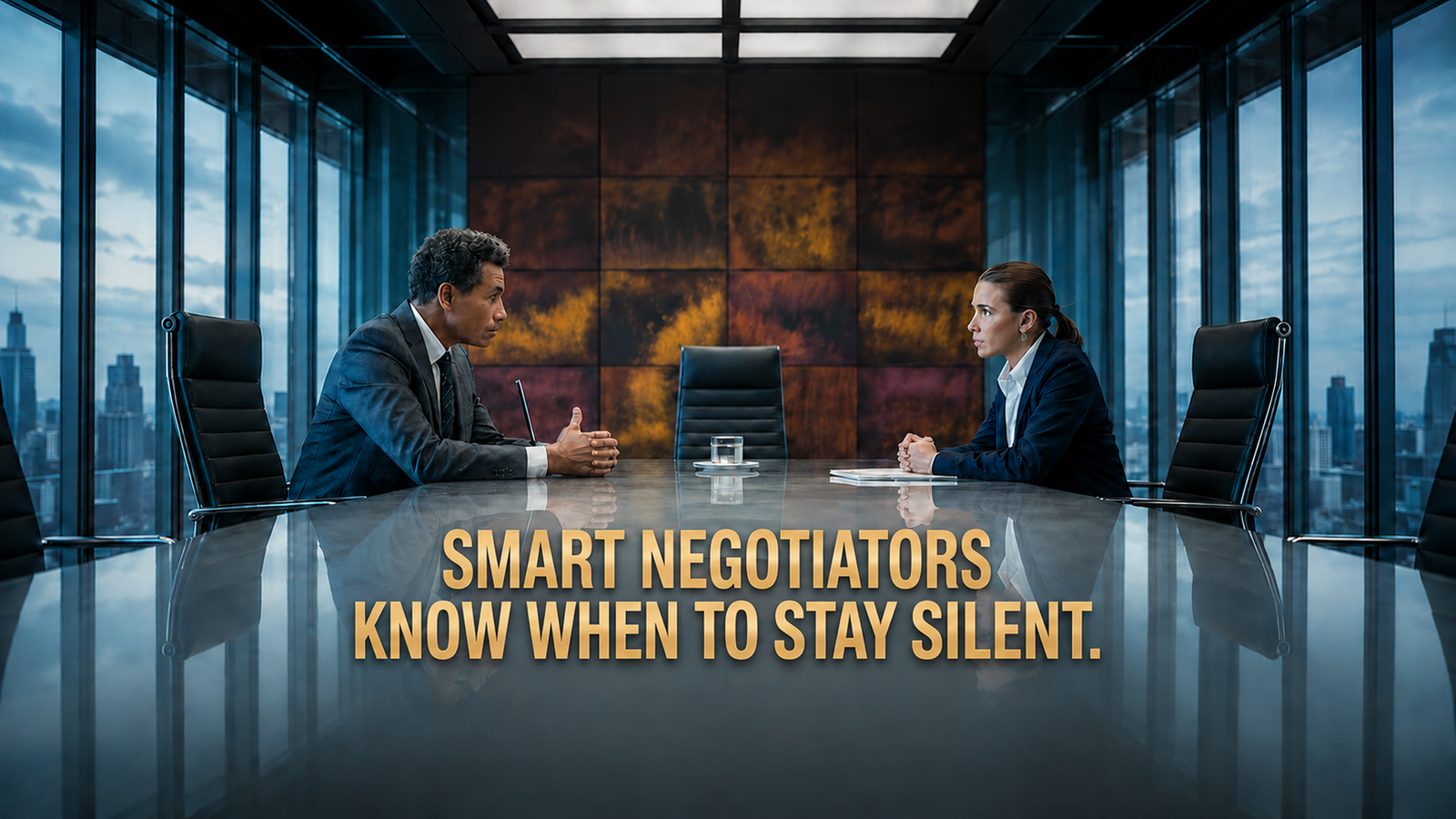
What if silence was your most powerful negotiating tool?
Most negotiation advice tells you what to say. The most underused tool is the opposite — knowing when to say nothing.
Negotiation prep usually focuses on your strengths, your priorities, and your limits. One tool rarely makes the list: silence. I have always been fascinated by how something so simple can have such a profound impact, and over the years I have watched clients transform their clarity, confidence, and authority simply by learning to pause.
What MIT discovered about staying silent
This is not just intuition. Research from MIT Sloan, led by Jared Curhan, found that pauses during a negotiation tend to precede breakthroughs — in fact, breakthroughs were more likely to follow a silence of at least three seconds than to occur at any other point in the conversation. A pause interrupts default, zero-sum thinking and shifts both people into a more deliberative, problem-solving mindset. The striking part: it improves outcomes not only for the person who pauses, but for both sides. Silence moves the conversation from win-lose toward a result where both parties feel heard.
What a pause does that words can’t
A pause does three things at once. It creates space for clearer thinking and better ideas. It lets both sides notice opportunities to create more value rather than simply divide it. And it projects confidence and control — which matter most in high-stakes conversations. When you slow down, your thoughts get clearer, your words more deliberate, and your presence stronger. You step into your own authority and own the space, instead of rushing to fill it.
Your secret weapon as a multilingual professional
Here is what I tell clients whose primary language isn’t English: the pause is your secret weapon. Many multilingual professionals feel they have to respond fast to prove fluency or confidence — so they rush, and the rushing is what undercuts them. But fluency was never about speed. It is about clarity, intention, and connection. When you pause, you are not falling behind; you are showing thoughtfulness and control. The silence is where your power sits.
The three-second rule
Try this in your next meeting. When you are asked a hard question or handed an offer, pause and count silently to three before you respond. Three seconds is the sweet spot — long enough to think, not so long that it drags. You may be surprised how often the other person fills the gap themselves: they rethink, reveal more, or even improve their offer.
If you need more than three seconds, give the silence a frame instead of an “umm”: “Let me take a moment to think about that.” It keeps the conversation flowing while buying you real thinking time, and it makes you sound more deliberate, not less prepared.
When the silence feels too long
Almost always, the silence feels far longer to you than it does to anyone else. Three seconds in your own head can feel like ten — but to the person across the table, it simply reads as composure. That flicker of discomfort you feel is not a signal to rush. It is the exact moment most people cave: they fill the gap, soften their position, or talk themselves out of a strong offer just to make the silence stop. Staying in it, calmly, is the whole skill. And it is a skill — start with low-stakes moments, a team check-in or a quick call, where a pause costs you nothing, and let it become familiar. By the time you are in a real negotiation, the silence will feel like yours to use, not something to survive.
From the deal table to the boardroom
For a mid-level professional, the pause is what stops you from blurting a number you regret in a vendor call, or agreeing to a deadline before you have thought it through. For a senior leader, it is what holds steadiness in a high-stakes negotiation, a board discussion, or a difficult client conversation — where the person most comfortable with silence usually controls the room. At every level the same truth holds: the one who can sit with a pause is rarely the one under pressure.
Try it in your next hard conversation
The next time you feel the urge to rush, step into the silence instead. Count to three. Notice what happens.
If responding with calm authority under pressure is something you want to make reliable, let’s talk — book a free discovery call.
Reference
In negotiation, use silence to improve outcomes for all. MIT Sloan Ideas Made to Matter (research led by Jared R. Curhan). https://mitsloan.mit.edu/ideas-made-to-matter/negotiation-use-silence-to-improve-outcomes-all