You are not a different person in English. You are operating in a different frame — and once you see it, a lot of what feels hard about working in a non-primary language starts to make sense.
My first months in Tokyo, I watched my Japanese friend bow on the phone. Deep, automatic bows — to someone who could not see her. I asked her why. She said, “It just comes.” Within six months, I was doing it too: bowing on calls, nodding with certain words, no thought behind it. The language carried the gesture, and my body followed.
Over eight years in Japan, something deeper shifted. As my Japanese improved, I could read honne and tatemae — the space between what is said and what is meant. In English, even when I understood the idea perfectly well, those cues stayed invisible. My English-speaking brain simply worked differently. Years later in Germany I noticed the same thing: as my German improved, the directness I had once read as rude became something I now value for its clarity.
For years I assumed this was personal — a quirk of having lived in many countries. It is not.
What cultural frame switching is
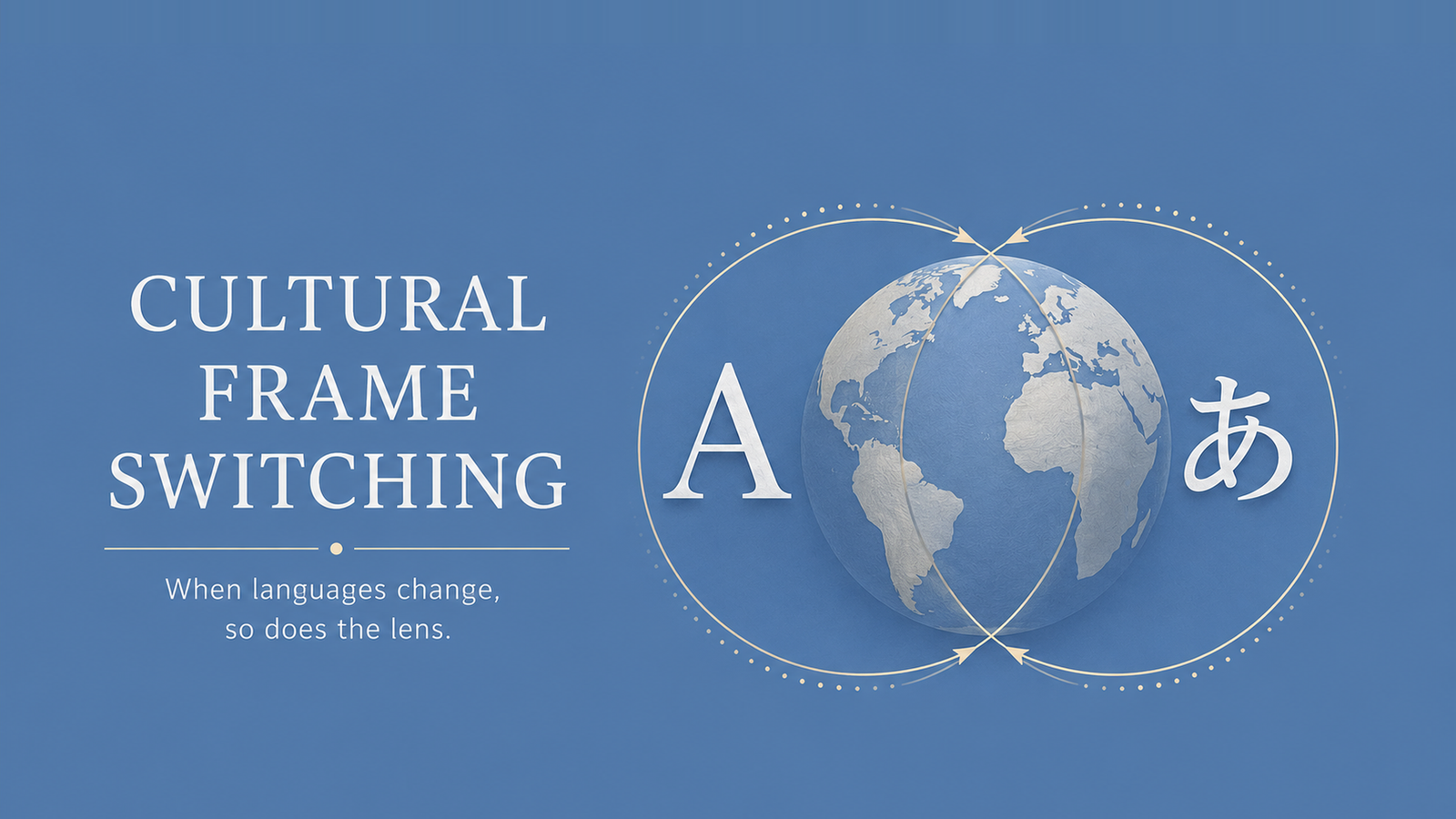
There is a name for it. Cultural Frame Switching is the term researchers use — a concept established by Hong, Morris, Chiu, and Benet-Martínez (2000) — for the way multilingual and multicultural people shift how they express themselves and how they read others depending on the language they are operating in. It is not performance. It is a real cognitive shift. Switching languages activates a different cultural frame, and that frame shapes how meaning travels between you and the person across the table.
The two shifts that happen when you change languages
In my own experience, and my clients’, the switch shows up in two places at once. I describe them in plain terms.
How you come across. Your body, tone, gestures, eye contact, pauses, and level of directness all adapt to the norms of the language you are speaking — a slight bow in Japanese, a firmer handshake in German business, a softer or sharper tone. Much of it happens without you deciding.
How you read others. Your perception changes too. In one language you pick up implied meaning, hierarchy, or quiet disagreement easily; in another, those same cues stay invisible. You interpret silence differently. You sense the intent behind the phrasing — or you miss it.
This two-part view — how you come across and how you read others — is my own way of articulating the concept, and it is more useful at work than the usual “different cultures communicate differently,” because it tells you exactly where to look.
Why this matters
Here is the part most people miss. When you speak English as an additional language, the person across from you is often shifting too. Both of you are slightly displaced from your own cultural frame, which is exactly why the cues get harder to read on both sides.
That is why fluency is not just vocabulary. The frame you are in shapes trust and authority, it changes negotiation dynamics and how value gets created, it affects how quickly people build relationships with you and how your leadership is perceived, and it determines how accurately you read what is really being decided in an international meeting.
If you are mid-level, this is the quiet gap you feel when you go silent in an English meeting and wonder where your sharper self went. If you are senior, it is what sits beneath a stalled negotiation or a message that did not land with an international board. The expertise is the same. The frame is what changed.
Fluency is moving inside the frame and still sounding like you
Fluency is not the absence of an accent or a flawless sentence. It is the ability to move confidently inside the English frame while still sounding like you — keeping your presence, your sharpness, and your intent, even when the cues are harder to read. English-me, German-me, and Japanese-me are all real. They are simply not identical. The goal is not to flatten them into one. It is to make sure the version of you in English carries the same presence as the version in your primary language.
Your move
The next time you switch into English, notice what changes first — your tone, your gestures, your directness, or how much of yourself you let into the room. That noticing is where the work begins.
If the version of you in English does not yet carry the same presence as the version in your primary language, that gap is exactly what coaching closes. You can book a free discovery call to talk it through.
Reference Hong, Y., Morris, M. W., Chiu, C., & Benet-Martínez, V. (2000). Multicultural minds: A dynamic constructivist approach to culture and cognition. American Psychologist.