Your presence speaks before you do. Before you have said a single word in a meeting, the people in the room have already begun deciding whether to trust you — and that first read shapes how everything you say next is received.
This is not just a hunch. In one well-known study, people formed reliable impressions of trustworthiness from a face after as little as 100 milliseconds (Willis & Todorov, 2006). A meeting is more than a face, of course — but it supports what many of us experience: people start forming impressions almost instantly. The good news is that presence is not a fixed trait you are born with. It is something you can build.
In 25+ years coaching professionals across business, academia, and training — in six countries, and in three languages I learned as an adult — I have seen the same pattern again and again. Capable, fluent people hold back because they are waiting to feel “ready.” Clients like Fujifilm, Ralph Lauren, TÜV SÜD, and ECT did not come to me for grammar. They came because they wanted to be heard. Presence is where that starts.
What presence actually is
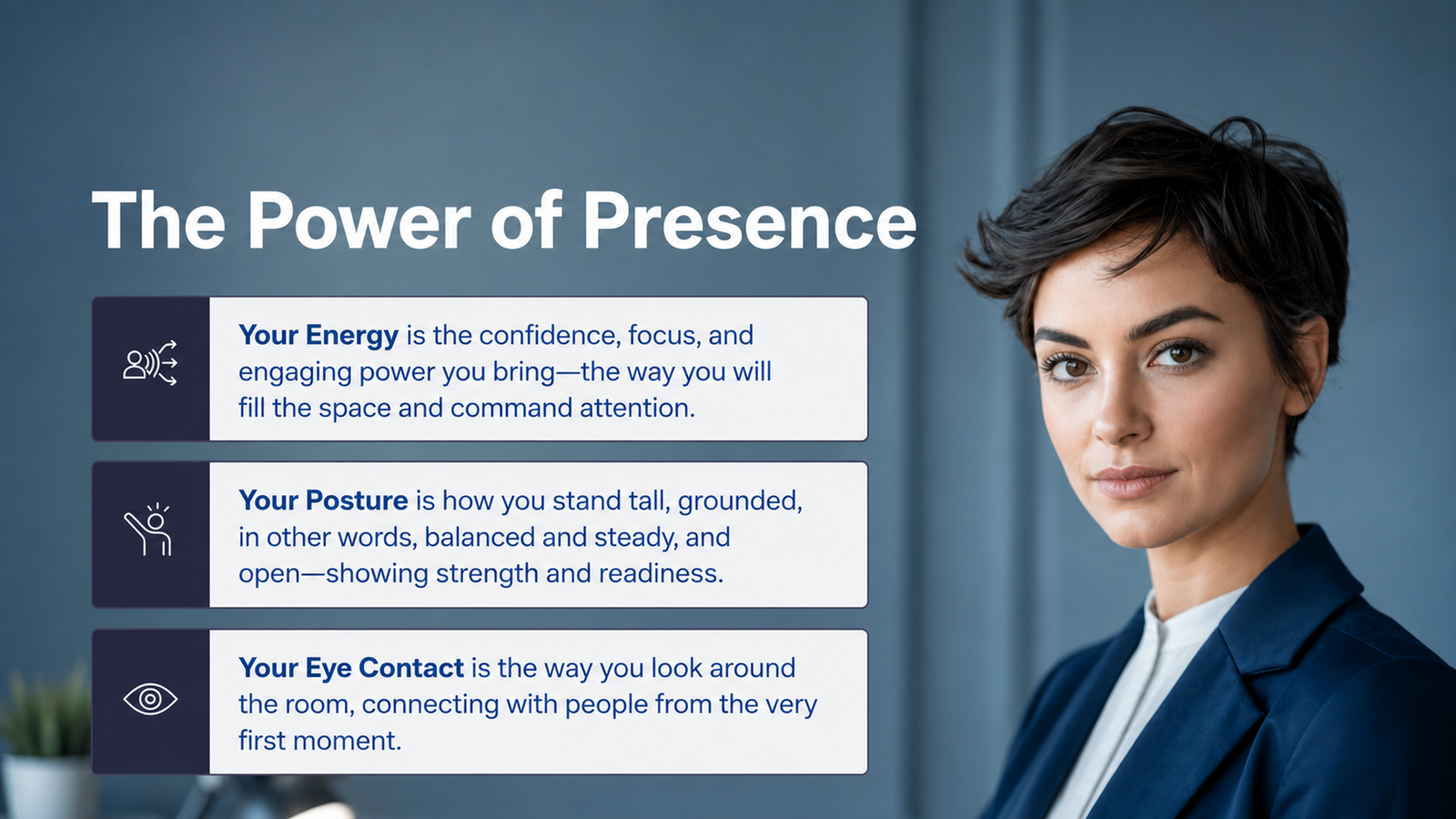
Presence is not charisma reserved for a lucky few. It is the energy, posture, and eye contact you bring into a room — three things you can control on purpose. Together they set the tone for how your message is received, often before you speak. Let me take each one in turn.
Your energy sets the tone
Your energy is the confidence, focus, and engaging power you bring — the way you fill the space and hold attention. People feel your energy before they process your words. Walk in distracted or apologetic and the room reads it. Arrive focused and present and the room settles and pays attention. You do not need to be the loudest person there; you need to be the most deliberate. Decide how you want to land before you walk through the door.
Your posture signals strength and readiness
Your posture is how you stand and sit — tall, grounded, balanced, and open. It signals strength and readiness without a single word. Posture that is steady and squared to the room tells people you belong there. Posture that shrinks or closes off quietly undercuts even your best point. You can change how you are perceived in a meeting simply by changing how you hold yourself in it.
Your eye contact builds connection
Your eye contact is the way you look around the room and connect with people from the very first moment. It is how you turn a presentation into a conversation. Steady, warm eye contact says: I see you, and I am speaking to you, not at you. It builds trust faster than any clever phrase. In a virtual meeting, this means looking into the camera rather than at the faces on your screen — a small shift with a surprisingly big effect.
Why this matters at work
Presence is not only for the boardroom. It works at every level, in the moments your career is actually built on.
If you are mid-level, presence is what lets you speak up in a team meeting instead of silently rehearsing the comment you never make. It is what carries your point in a cross-functional or project call where louder voices dominate. It is how you become the person who is remembered — rather than watching the people who felt “ready” get the visibility while you did the work.
If you are senior, presence is what holds a negotiation steady, what lets you lead a room rather than merely inform it, and what lands a message with a board or an executive audience. At every level the same truth holds: how you show up decides how your message is received.
You do not have to wait until your English is perfect
Here is what I tell every client. Improving your Business English matters — communicating with clarity and precision in English is critical, and I will never tell you otherwise. But do not wait to be perfect before you start making an impact.
The problem is rarely your grammar. It is confidence, presence, and strategic delivery in high-stakes English. That is the layer that opens doors — and it is the layer that artificial intelligence cannot do for you. AI can polish a sentence; it cannot walk into the room as you. You can communicate with confidence and influence right now, exactly as you are.
Your move this week
Pick one — energy, posture, or eye contact — and amplify it in your next meeting. Just one. Then notice what changes in how people respond to you.
If you would like help making presence something you can rely on, not just on a good day, let’s talk. You can book a free discovery call or download the Power of Presence summary to keep these three areas in front of you.
Reference
Willis, J., & Todorov, A. (2006). First impressions: Making up your mind after a 100-ms exposure to a face. Psychological Science, 17(7).